


Urinary tract infections (UTIs) during menopause are a common and often frustrating experience for many women. If you’re noticing more frequent urges to urinate, increased
⭐⭐⭐⭐⭐ Rated 5 Stars by Over 290 Patients — Read Our Reviews on Google!

Susan Winograd, MSPT, is a licensed physical therapist, pelvic floor specialist, and founder of Pelvicore Rehab & Wellness in Boca Raton, Florida. She earned her Master's degree in Physical Therapy from the College of Staten Island in 1998 and has spent nearly 30 years developing deep clinical expertise in pelvic floor dysfunction, women's and men's pelvic health, pre and postnatal care, chronic pelvic pain, and scar tissue release therapy. Susan takes a whole-body approach to healing — identifying and treating the root cause of her patients' symptoms rather than managing them in isolation. She is a member of the American Physical Therapy Association and has been featured on multiple health and wellness podcasts as a recognized pelvic floor specialist in South Florida.
Your body is doing something extraordinary. Let's help it heal.
Whether you're preparing for birth or recovering from it, pelvic floor physical therapy makes a profound difference — less pain, faster recovery, and a stronger foundation for everything ahead. Susan has worked with pregnant and postpartum women for nearly 30 years.
Many women ask me the same question as their due date gets closer: “Is there anything I can actually do to prepare for birth?”
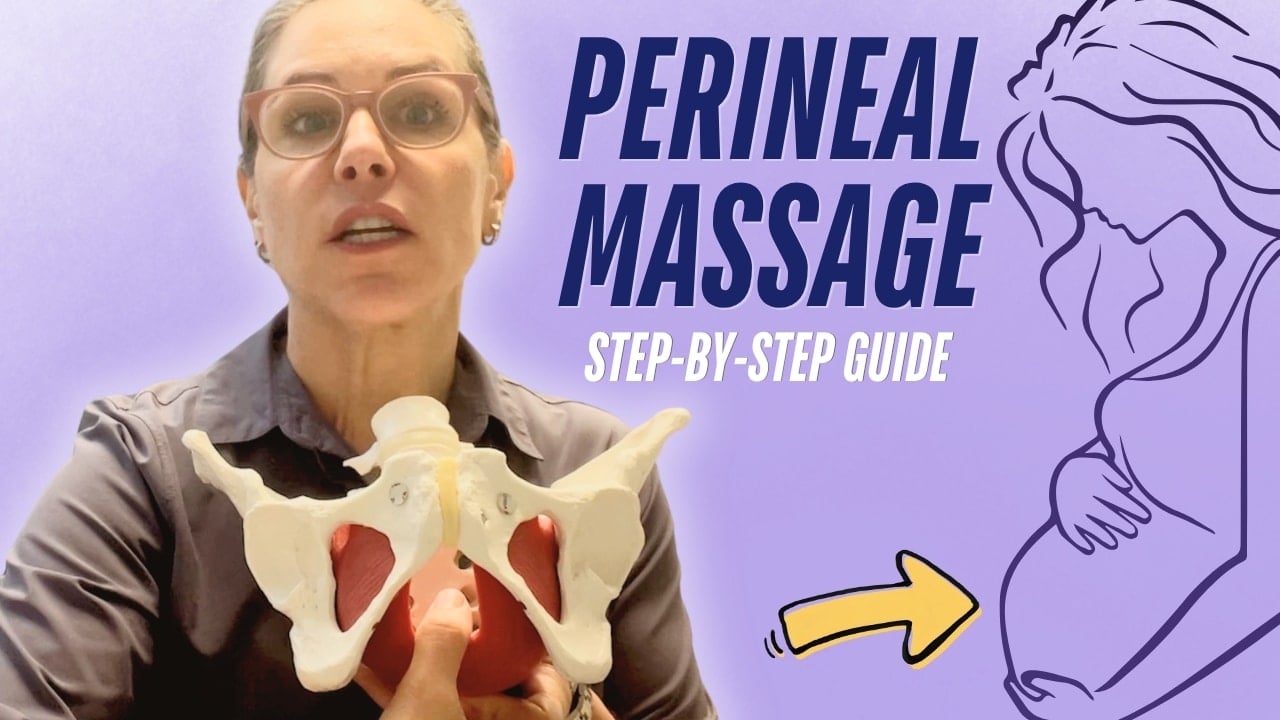
Yes. There is. And one of the most valuable tools you can add to your toolbox is to perform perineal massage during pregnancy.
It sounds intimidating if you’ve never heard of it, but the idea is simple — and the payoff can be real. Think of it the way you’d think about gently stretching before exercise: you’re preparing the tissues ahead of time so your body feels more ready when the moment comes.
Your perineum is the area between your vaginal opening and your rectum. During childbirth, these tissues need to stretch significantly to allow your baby to pass through.
Perineal massage is a gentle, deliberate way of preparing that area before labor. You’re not forcing anything. You’re helping the tissues become more supple, and — just as importantly — you’re teaching your brain and your pelvic floor that this kind of stretching is safe.
Research suggests that starting perineal massage around 34 to 35 weeks of pregnancy — especially for first-time moms — may help reduce the likelihood of significant perineal tears and the need for an episiotomy.
There’s a second benefit that doesn’t get talked about enough: it helps you become familiar with the sensation of stretching in the perineum. When you already know what that pressure feels like, pushing during labor can feel far less intimidating. You’ve felt a version of it before. You know you can breathe through it.
That familiarity is its own kind of preparation — for your body and for your nervous system.
Here’s exactly how to do it.
There’s no single “right” position — choose what lets you reach comfortably. Many women like:
If your belly makes it difficult to reach, your partner can absolutely do this for you. We teach partners how to help in the office all the time — it’s completely normal, and it can be a meaningful way to prepare together.
Wash your hands and trim your fingernails — we don’t want any scratching. Then apply a generous amount of a pregnancy-safe, water-based lubricant or vitamin E oil.
Whatever you choose, make sure it’s clean and, ideally, recommended by your healthcare provider.
If you’re doing it yourself, your thumb is easiest. Place one or two thumbs just inside the vaginal opening. (If your partner is helping, they’ll typically use their index finger instead.)
Gently press downward toward the rectum. Then, picturing the lower part of your vaginal opening as a clock face, press gently out toward 4 o’clock, then toward 8 o’clock, moving in a smooth U-shape along the lower half.
Hold each stretch for about 60 to 90 seconds. Continue moving through that U-shape for about 5 to 10 minutes, 3 to 4 times a week.
You should feel a stretching sensation — a strong stretch — but not pain. This isn’t something you need to guard against or brace through. If it hurts, ease off.
Here’s where perineal massage becomes about so much more than tissue.
As you massage, focus on your breathing. Take a slow breath in through your nose. As you exhale, consciously allow your pelvic floor to soften and lengthen.
This is a genuine skill — and it’s an invaluable one for labor. So often, when we feel pressure, our instinct is to tighten and clench. Perineal massage gives you a low-stakes chance to practice the opposite: relaxing and releasing into the sensation instead of tensing against it. That’s exactly what you’ll want to be able to do when it’s time to push.
I want to be clear about something, because it changes how you approach this entirely.
The goal isn’t to force the tissues to stretch. The goal is to teach your brain and your pelvic floor that it’s safe to relax.
Over time, two things tend to happen: the tissues become more supple, and you become more comfortable with the sensation of stretching. Both matter. Both serve you on delivery day.
Perineal massage is powerful, but it’s one piece of birth preparation — not the whole picture. It works best alongside:
Together, these help your body feel more prepared and more confident heading into labor.
Every birth is unique, and no technique can guarantee you won’t tear. But giving your tissues and your nervous system the opportunity to prepare is one of the best gifts you can give yourself before meeting your baby. Put these tools in your toolbox — and know they’ll be there for you to reach for.
If you’d like guidance on perineal massage or a personalized birth-prep plan, we’d love to help.
Have questions about your pelvic health during your postpartum journey? Book a Free Discovery Call
Want more pelvic floor health tips? Subscribe to our YouTube channel
📺 Related: Reset Your Pelvic Floor with Reverse Kegels & Breath
Pregnancy and postpartum care that goes deeper.
Leaking, prolapse, diastasis recti, C-section recovery, painful intercourse after birth — these are conditions Susan treats every day. You don't have to wait and hope they resolve on their own. A free 15-minute call is the first step toward real recovery.
Or book online — free, no obligation
Click & Share
More Wellness & Rehab Insights
Urinary tract infections (UTIs) during menopause are a common and often frustrating experience for many women. If you’re noticing more frequent urges to urinate, increased
Pelvic floor muscle strengthening exercises are most commonly referred to as Kegels. The purpose of “Regular” Kegel exercises is to strengthen pelvic floor muscle that