


Have you been doing crunches, planks, and every core exercise you know — and your mummy tummy still won’t budge? It may not be because
⭐⭐⭐⭐⭐ Rated 5 Stars by over 300 Patients — Read Our Reviews on Google!

Susan Winograd, MSPT, is a licensed physical therapist, pelvic floor specialist, and founder of Pelvicore Rehab & Wellness in Boca Raton, Florida. She earned her Master's degree in Physical Therapy from the College of Staten Island in 1998 and has spent nearly 30 years developing deep clinical expertise in pelvic floor dysfunction, women's and men's pelvic health, pre and postnatal care, chronic pelvic pain, and scar tissue release therapy. Susan takes a whole-body approach to healing — identifying and treating the root cause of her patients' symptoms rather than managing them in isolation. She is a member of the American Physical Therapy Association and has been featured on multiple health and wellness podcasts as a recognized pelvic floor specialist in South Florida.
Your body is doing something extraordinary. Let's help it heal.
Whether you're preparing for birth or recovering from it, pelvic floor physical therapy makes a profound difference — less pain, faster recovery, and a stronger foundation for everything ahead. Susan has worked with pregnant and postpartum women for nearly 30 years.
You had a baby. And now, weeks or even months later, sitting feels like you’re sitting on a bruise.
Maybe it’s the moment you lower yourself onto the couch. Maybe it’s standing back up. Maybe it’s the drive to your pediatrician appointment, or the long stretch of holding and feeding your baby in the same position. Wherever it shows up, the pain is right there at the very bottom of your spine — sharp, tender, and impossible to ignore.
If that’s you, you’re not alone. Tailbone pain after pregnancy is very, very common.
But here’s what I want you to know, and it’s something we say all the time at Pelvicore because we mean it every single time: common does not mean normal.
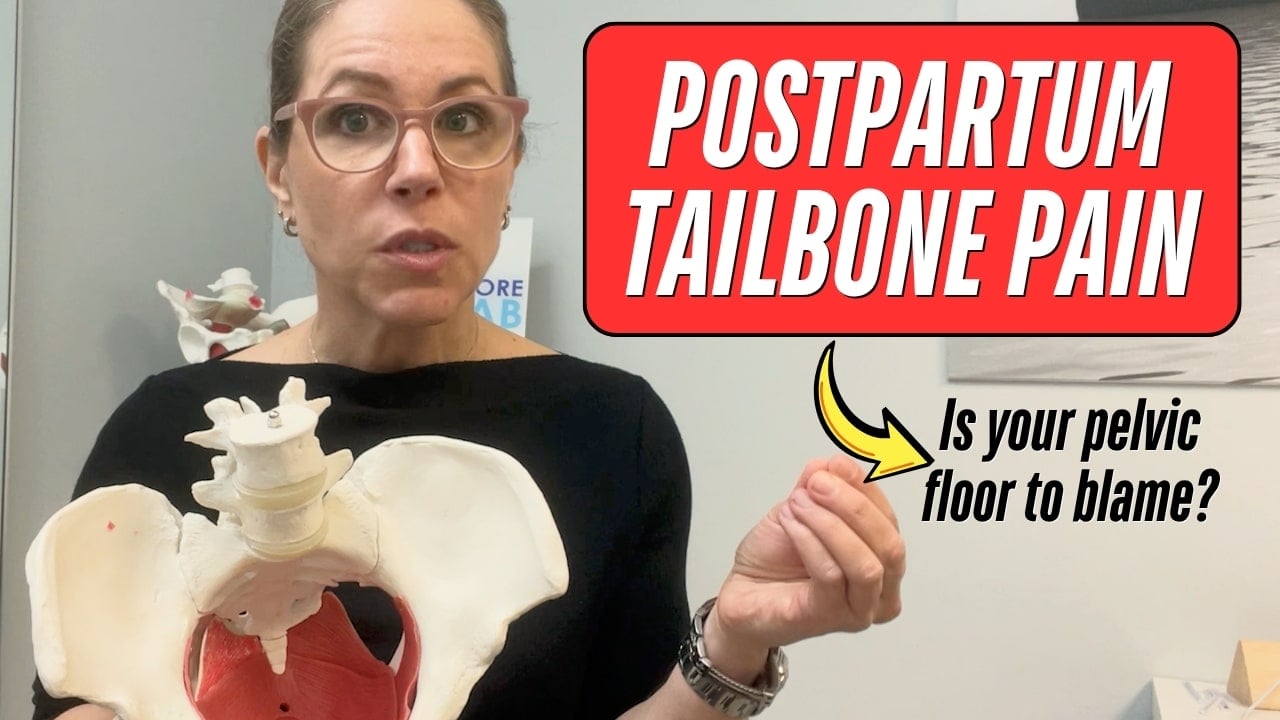
Your tailbone — the coccyx — is the small, triangular set of fused bones at the base of your spine. Pain in this area is called coccydynia, and postpartum women are one of the groups most likely to experience it.
A little soreness in the first few weeks after delivery? That can happen. Your body has been through a tremendous amount, and some tenderness during early recovery isn’t unexpected.
But if you’re still having tailbone pain weeks or months later — or if it’s affecting your ability to comfortably sit, exercise, care for your baby, or simply get through your normal daily activities — it’s time to pay attention to the signals your body is giving you. That’s not a phase to wait out. That’s information.
There are two main things happening, and most women only ever hear about the first one.
During pregnancy and childbirth, your tailbone takes on real mechanical stress. As your baby moves through the pelvis, the coccyx can be compressed, strained, or even pushed backward out of its normal position.
This is especially common after:
Any of these can leave the coccyx irritated, hypermobile, or sitting in a position it wasn’t in before — and that irritation is what you feel every time you put weight through it.
This is the piece almost nobody explains, and it’s often the reason tailbone pain lingers long after the tissues should have healed.
A lot of your pelvic floor muscles insert directly onto the tailbone. They are physically anchored there. So the coccyx isn’t just a bone that got bumped during delivery — it’s an attachment point for a muscle group that just went through one of the most demanding events of your life.
If those pelvic floor muscles are tight, overworking, or protecting that area after birth, they will keep pulling on the tailbone. And that constant pull generates pain — day after day, long after you’d expect to feel better.
This is why so many women get told “it should resolve on its own,” wait patiently, and then find themselves six months out still bracing every time they sit down. The bone may be fine. The muscles pulling on it are not.
The good news is that there is a ton you can do. Here’s where I’d start.
Get the weight off the tailbone and off that pelvis. Most of us sit tucked back onto the sacrum and coccyx, which puts direct pressure exactly where it hurts. Shifting to sit up over your sit bones — the bony points you can feel underneath you — takes load off the tailbone immediately.
A wedge cushion or a cushion with a cutout at the back can help enormously in the meantime, particularly for long drives and feeding sessions.
360-degree breathing means allowing your ribcage to expand in all directions — front, sides, and back — rather than only lifting the chest or gripping the abdomen. This breathing pattern lets the pelvic floor lengthen and relax on the inhale, which is exactly what an overworking, guarded pelvic floor needs. It’s simple, it’s free, and it’s one of the most effective things you can do to give those muscles permission to let go of the tailbone.
This one surprises people, but it matters more than you’d think. Straining on the toilet loads the pelvic floor and puts direct pressure through the coccyx, and postpartum constipation is extremely common. Staying hydrated, getting adequate fiber, using a footstool to bring your knees above your hips, and not holding your breath and bearing down all reduce that repetitive strain on an already irritated area.
Every postpartum mom should see a pelvic floor physical therapist — not just those with pain. A pelvic floor PT can assess whether your pelvic floor is actually recovering optimally, whether those muscles are tight and pulling on the coccyx, and whether your core system is coordinated.
That last part matters. Your diaphragm, deep abdominals, pelvic floor, and back muscles need to work well individually — but they also need to work together as a system. When one part is guarding or compensating, the whole system loads unevenly, and the tailbone often ends up absorbing the difference.
Reach out to a pelvic floor physical therapist if:
You don’t need to wait until it’s unbearable, and you don’t need a certain amount of time to have passed. If it’s affecting your life, that’s reason enough.
What’s common is not normal. And feeling pain does not mean you have to accept it as your new baseline.
Postpartum tailbone pain is treatable. There are real, identifiable reasons it happens, and there are real, effective things that address it — starting with understanding the pelvic floor’s role in the whole picture.
If tailbone pain is part of your postpartum experience, we’d love to help you sort out what’s driving it.
Have questions about your pelvic health during your postpartum journey? Book a Free Discovery Call
Want more pelvic floor health tips? Subscribe to our YouTube channel
📺 Related: Reset Your Pelvic Floor with Reverse Kegels & Breath
Pregnancy and postpartum care that goes deeper.
Leaking, prolapse, diastasis recti, C-section recovery, painful intercourse after birth — these are conditions Susan treats every day. You don't have to wait and hope they resolve on their own. A free 15-minute call is the first step toward real recovery.
Or book online — free, no obligation
Click & Share
More Wellness & Rehab Insights
Have you been doing crunches, planks, and every core exercise you know — and your mummy tummy still won’t budge? It may not be because
Know the top 3 signs you should look out for if you suspect you are experiencing pelvic floor dysfunction. If you have any of these